

Truck Maintenance Tips to Keep Your Vehicle in Tip-Top Shape
A Ford truck is a workhorse, helping many owners access and deliver heavy loads to off-road worksites and destinations. Therefore, proper truck maintenance is crucial to ensure the vehicle's reliability and extended functional lifespan.
At Ford Riser, we have a team of professional Ford specialists who can provide quality truck service and maintenance tailored to your driving behavior and the truck's model.
Below are preventative truck maintenance tips to help you keep your vehicle running for the longest time possible.
Essential Truck Maintenance Tasks
Some routine truck maintenance tasks are crucial. However, some Ford truck owners ignore them, forgetting that these simple checks are what the truck needs for maximum function and dependability.
Oil Changes
Clean oil protects your truck's engine by ensuring proper lubrication of internal components. The engine oil becomes contaminated with dirt, dust, and debris from harsh road conditions and environmental elements. If left unchanged, old oil breaks down and forms sludge, damaging the engine and leading to costly repairs or replacement.
Always check your owner's manual to determine how often you should change the engine oil. Still, the Ford Motor Company recommends you change the engine oil every 7,500 miles or every six months.
Tire Rotation
Tire rotation is another critical maintenance truck to ensure the tire treads wear evenly. Typically, the tires wear unevenly, especially the front tires. They tend to wear quicker than the rear tires because they turn and brake more frequently and bear the majority of the truck's weight. Rotating the tires ensures even wear distribution, extending tire lifespan.
Brake Inspections
When transporting or hauling a full load, you want to ensure your Ford truck stops safely. Hence, inspect the brakes frequently and replace them once they reach the minimum wear condition. Additionally, check for uneven brake wear on all wheels to determine an imbalanced brake system. If that's the case, have them repaired or adjusted to ensure maximum brake performance.
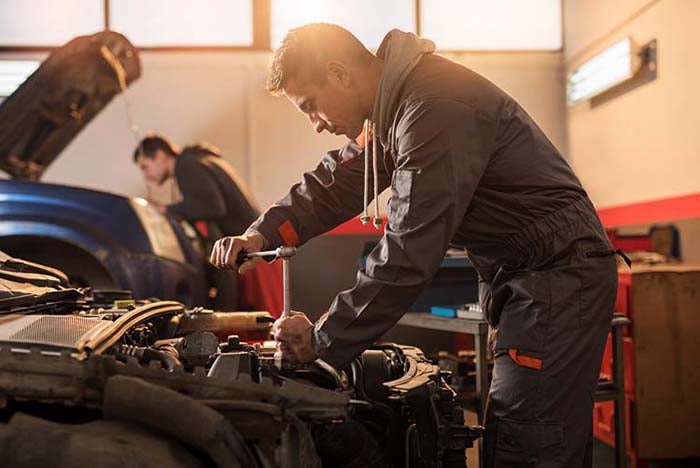
Check and Maintain Fluid Levels
Besides replacing the engine oil, it's essential to check and maintain other car fluids. Identifying decreasing fluid levels early helps you diagnose problems and keep your truck in the best shape.
Engine coolant
The engine coolant/anti-freeze keeps your engine cool and prevents the water in the fluid from freezing during winter. Keeping the coolant at optimal temperatures is crucial for the engine's maximum performance and for reducing engine issues related to extreme temperatures.
Transmission fluid
Your truck's transmission doesn't consume liquid. Even so, checking the fluid level if you experience problems (such as transmission slips, shifts, or signs of fluid leakages) is crucial. The automatic transmission fluid expands when warmed. Therefore, you must check the liquid level and temperatures accurately. Here's how to do that:
- Drive the vehicle a distance of 19 miles (30 kilometers) to reach the recommended operating temperatures
- Locate the dipstick and insert it into the filler tube
- Remove the dipstick and inspect the fluid level. If the liquid level isn't at the designated point for normal operating or ambient temperature, it's time for a fluid change.
Brake fluid
The brake fluid is a hydraulic fluid, meaning it's responsible for moving the various parts of the truck's brake system. Over time, the fluid absorbs moisture from the air, compromising its proper functioning. That's why you should replace the brake fluid regularly for good braking response.
Tips for Maintaining the Truck's Engine
The engine is the "heart" of your truck, generating the power distributed to the wheels through the transmission system. In short, without the engine, the vehicle won't move. Hence, you must properly maintain it to ensure proper function and extended durability.
The following are tips for maintaining a Ford truck's engine.
Routine Air Filter Change
The engine's air filter prevents dirt, dust, pollen, and debris from entering the air intake system. With time, the filter becomes clogged with these contaminants, reducing the amount of clean air getting to the motor. Routine air filter replacement ensures clean air gets to the engine, ensuring proper combustion and optimal engine performance. A clean filter also prevents potential engine damage and helps deliver better fuel efficiency.
Spark Plug Replacement
In an engine, spark plugs produce the spark of electricity required to ignite the combustion needed to start the truck. If the spark plugs aren't working properly, you can experience various issues, including:
- Slow start or engine not starting at all
- Rough engine sounds
- Engine misfires
- Poor or sluggish acceleration
- Higher-then-usual fuel consumption
It's recommended that you replace the spark plugs every 3,000 miles. By changing the spark plugs, you can avoid the issues mentioned above and enjoy a range of benefits, such as:
- Consistent combustion system
- Improved fuel economy
- Smooth vehicle starts
- Reduced harmful emissions
Fuel System Cleaning
A Ford truck's fuel system comprises several components: fuel tank, fuel filter, fuel injectors, fuel pump, fuel pressure regulator, throttle body, and oxygen sensor. All these components must be functioning well to avoid several issues, including:
- Engine misfiring
- Difficult engine starts
- Engine misfires
Fuel system maintenance involves a routine of investigation and cleaning. Generally, the fuel system needs a cleaning treatment every 3,000-5,000 miles, depending on your truck's year, model, mileage, and driving pattern.
Deep-cleaning a severely clogged fuel system involves using powerful chemicals, cleaning agents, specialized equipment, and professional expertise. It's a time-consuming process that involves replacing the fuel filter, cleaning the fuel lines, fuel injectors, and other system components. It's best to partner with a professional Ford dealer for proper diagnosis and repair.
Maintaining the Truck's Battery
Your truck's battery powers many of the components and systems in the vehicle, whether you own the all-electric Ford Lighting or the conventional internal combustion truck. Therefore, the battery must be fully-functioning, lest you find yourself on the roadside rather than driving on it.
Here are battery maintenance tips to help you keep the battery in tip-top shape:
Clean the Terminals
Your car battery features positive and negative terminals and connectors. These components become corroded over time, which makes cleaning them highly crucial. To do that, remove the positive and negative connectors. Apply a mixture of baking soda and distilled water to the terminals and use a brush to scrub away the corrosion. Ensure you don't connect the positive and negative terminals while doing so; otherwise, you'll start a spark. Once cleaned, replace the positive connector for effective power transmission to the negative connector.
Check the Voltage
You need to check the battery voltage using a voltmeter once a month to keep the battery in good health. A fully charged battery should have a voltage of about 12.7 V or more. If that voltage falls below 12.5 V, recharge the battery immediately.
Maintaining the Truck's Exterior
Cleaning your truck's interior ensures it achieves an attractive and shiny look. You can maintain the truck's exterior in several ways:
- Washing – Your truck's exterior endures a barrage of elements, including rock impacts, bird droppings, pollen, road dust, and bugs. Regular washing eliminates abrasive elements that could harm the paint. Moreover, this becomes particularly crucial in the winter, when sand and salt accumulation pose a significant threat to the paintwork.
- Waxing – Even with regular washing, the clear coat on the car will wear off over time, and the paint becomes prone to fading, discoloration, and rust. Waxing the exterior regularly preserves the clear coat that protects the paint from corrosive chemicals and elements while giving your ride an eye-catching shine.
Common Truck Maintenance Mistakes to Avoid
While preventative maintenance of your pickup truck costs money, neglecting or improperly performing maintenance tasks can result in significant problems. These issues can end up costing you more money in the long run and ultimately shortening the lifespan of your vehicle. Here are some common truck maintenance mistakes you should avoid:
- Not checking the tire pressure
- Ignoring oil and other fluid changes
- Failing to inspect or replace the brakes
- Failing to replace old windshield wipers
- Driving with old oil and air filters
- Not understanding the basics, such as jumpstarting the car or changing a flat tire
- Ignoring the check engine light
Your Ford truck is a superior vehicle, and we want to ensure it remains reliable and in good shape, whether it has traveled 10,000 or 100,000 miles. You can always schedule maintenance or repairs by contacting us at (501) 588-4696 or bringing your Ford truck to our 4201 Central Ave, Hot Springs, AR service facility.